Bitcoin is seen as freedom money. It is the FIRST cryptocurrency which does not rely on a centralized issuer or custodian. It is the result of many years of trying and development ever since home-computers became a thing. Ever since the internet (web1.0) was a thing.
Ever since its creation has the supporting network, its underlying security been rising.
The network getting more and more secure with each passing day. On a regular basis is it reaching new All Time Highs where it concerns hashrate (its security). The intricicaties of Bitcoin mining in regards to hashrates, profitable mining and the various mining possibilities are thoroughly explained in my course “Crypto Mining” which is available on gumroad.
Let us refresh and re-iterate (very briefly) what Bitcoin mining involves and what to look out for when you are eager to start mining. As quoted from the “Crypto Mining” course:
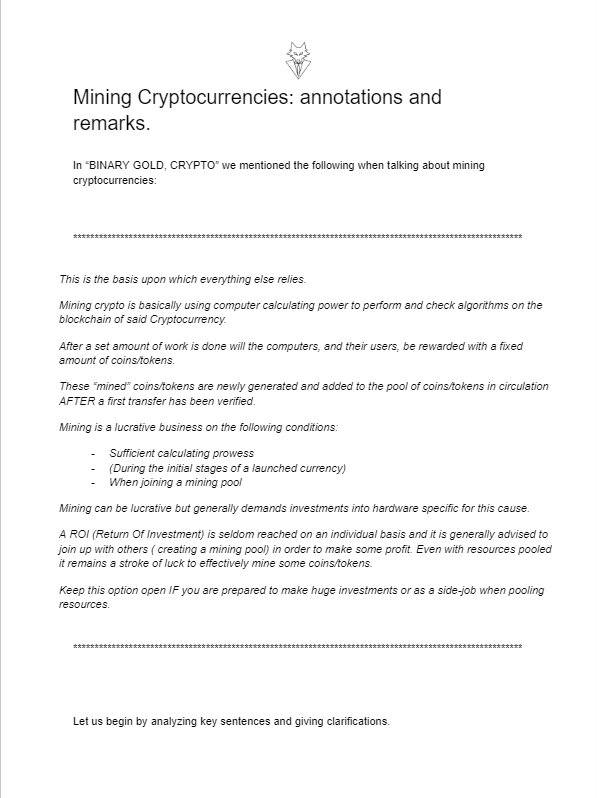
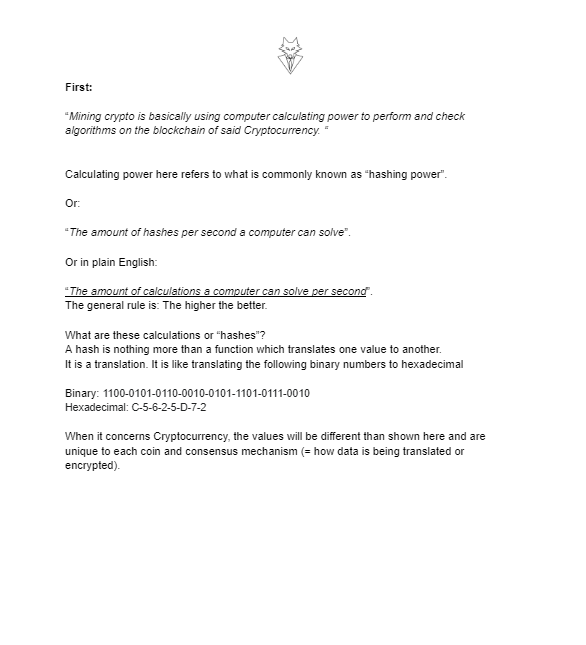
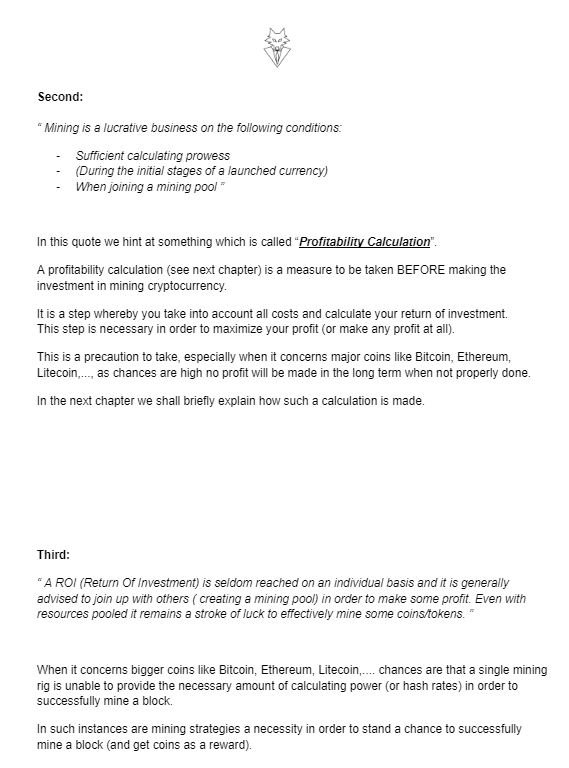
Now that we refreshed the importance or profitability calculations and what to generally look out for, let us deep-dive in the more “advanced” stuff and say that you are ready to buy a miner.
We could also say that you already HAVE a mining rig (or multiple ones) but want them to be more sustainable.
In this case-study, I will be making use of my experience as Project Engineer in renewable energy as well as my knowledge about farming and my experience as Bitcoin – Crypto educator (see my professional credentials here: LinkedIn).
Let us begin.
Step 1: How much energy is wasted with Bitcoin mining?
In this step, we are not talking about the various myths of Bitcoin and its possible impact on the environment. We are talking about how much “heat” an individual miner produces which goes to waste.
An interesting article to read about re-purposing wasted “heat”, mainly for huge Bitcoin mining centers, is to be found on the K33 Research website in an entry titled: “Repurposing waste heat from bitcoin mining can lower heating costs and mitigate emissions“.
My interest is mainly in the efficiency of converting electricity into “heat” as produced by the miners. This means I want to find out what percentage of electricity is being transformed into “heat” that would be otherwise wasted.
In a study titled “Heat Recovery from Cryptocurrency Mining by Liquid Cooling Technology” written by Nan Chen, Yunshui Chen and He Zhao and published on Intechopen we see the use of a Bitcoin miner (mainly the Whatsminer MicroBT M30S) being integrated into a sanitary hot water system that will produce 190L of sanitary hot water at a theoretical level of 60°C.
The miner itself is demanding, based on the technical description, 3268W of energy. If we add power consumption of the regulation and internal pump we’d be around a demand of 3.4kW (3400W) of energy to operate the system.
How to deduce the heat percentage?
This would depend on the amount of heat the coil can exchange. The aforementioned study luckily gave us the following details:
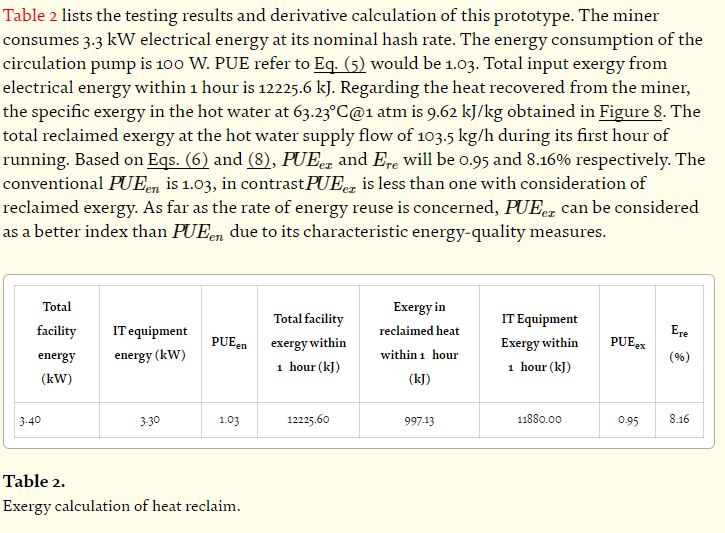
Important here is in the text mentioned “The specific exergy in the hot water at 63.23°C @1 atm is 9.62kJ/KG“. Knowing that the boiler itself contains 190L of water, and we take 1g/cm3 (or 1Kg/dm3) as density for water we find: 9.62kJ/KG * 1Kg/dm3 * 190L= 1827.8 kJ of energy which equals to 0.5077kW(1) in heat produced by the miner.
We now know that the miner demands a total of 3268W of energy and produces about 507.7W(1) in heat. This means that the percentual heat production is at about 15-16% of the total amount of energy used by the miner. That would have been 15-16% of energy otherwise wasted as heat.
(1)This is the amount of heat produced by the miner whereby its heat is captured in a refrigerant which, in turn, is being used to heat up water.
We shall respect 15% of energy produced by the miner as heat during the case-study.
Though a little annotation is in order as a variety of studies have shown numbers ranging from 20 – 40% in heat production. This lower percentage being mainly a result of using liquid cooling and all intermediaries to capture the heat. The miner itself is also a major influence as newer more powerful miners tend to produce less waste energy (heat) as they become more efficient.
Step 2: Designing the heating of the Greenhouse
Here comes the tricky bit. From my years as a professional in heating, ventilation and air-conditioning should I highlight the importance of the various factors which comes to heating a room, apartment or even a house. The needed amount of energy depends on:
- The materials used to built and their thermal transmittance
- The size/volume of the place
- Heating techniques used
- The airthightness of the place
In this case study I will use the following greenhouse available at a local Belgian DIY-shop:

From this I get the following information:
– Surface area of 1.85m * 2.08m = 3.85m2 surface area.
Though the roof is tilted, I am going to act as if the volume is square and take the height at 1.86m. This gives me a total volume to heat of 7.16m3.
– The greenhouse itself is entirely made from Polycarbon. To know how much energy is “lost” I will need to deduce the Thermal transmittance based on the Thermal conductivity of polycarbonate times the thickness of the plates used.
The Thermal conductivity of Polycarbonate is 0,20 W/(k.m). The panes themselves will be about 4mm thick. This will give me a Thermal transmittance of 0.20 W/(k.m) / 0.004m = 50 W/m2.K.
To know how much heat I will lose will I need to know the total surface area of the greenhouse exposed to the air. I will consider it as a rectangular cuboid. Based on the known dimensions the total surface area will be: (2x(1.85mx2.08m) + 2x(1.86mx2.08m) + (1.85mx1.86m)) = 18.87m2
To know the amount of energy “lost” is to multiply the Thermal transmittance by the total surface area which means a loss of 50 W/m2.K x 18.87m2 = 943.5W/k
This number is the amount of heat I will need to produce and compensate for. This is the amount of heat I will (theoretically) need to in order to maintain a stable temperature.
For convenience sake will I round-up and say that the greenhouse will need 1000W (or 1kW) in order to remain active frost-free during winter periods.
– Heating techniques.
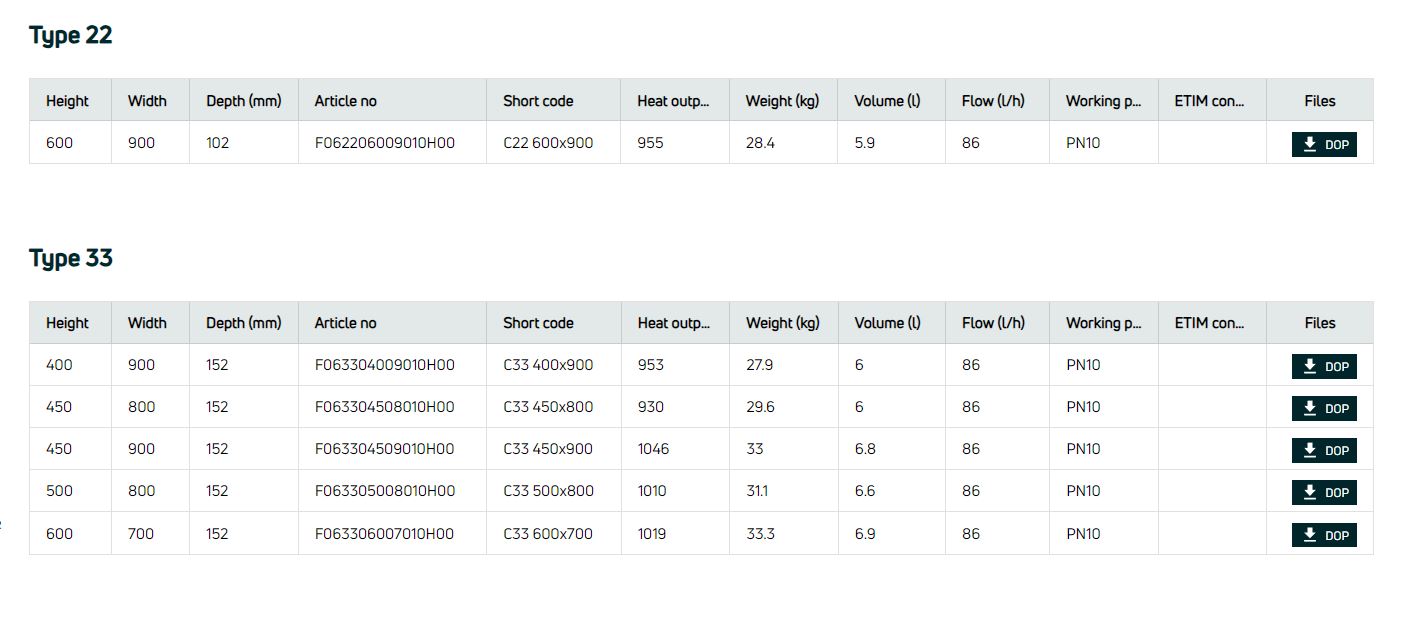
The most advised here is making use of a radiator. Remember that the previously mentioned miner only produces 507W (or 15% of used total energy) in heat and enables to heat-up a boiler of 190L to about 60°C. Using this heated-up water is the better choice as air is the worst medium to transfer heat. A small Type 22 radiator (see image below) (2 convection plates and 2 heating plates) of about 600mmx900mm is sufficient enough. To keep the ground frost-free can the outflow piping be laid in such a way that it heats up a part of the ground before returning back to the “mining boiler”.
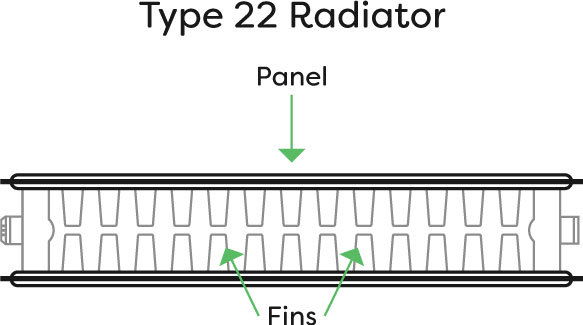
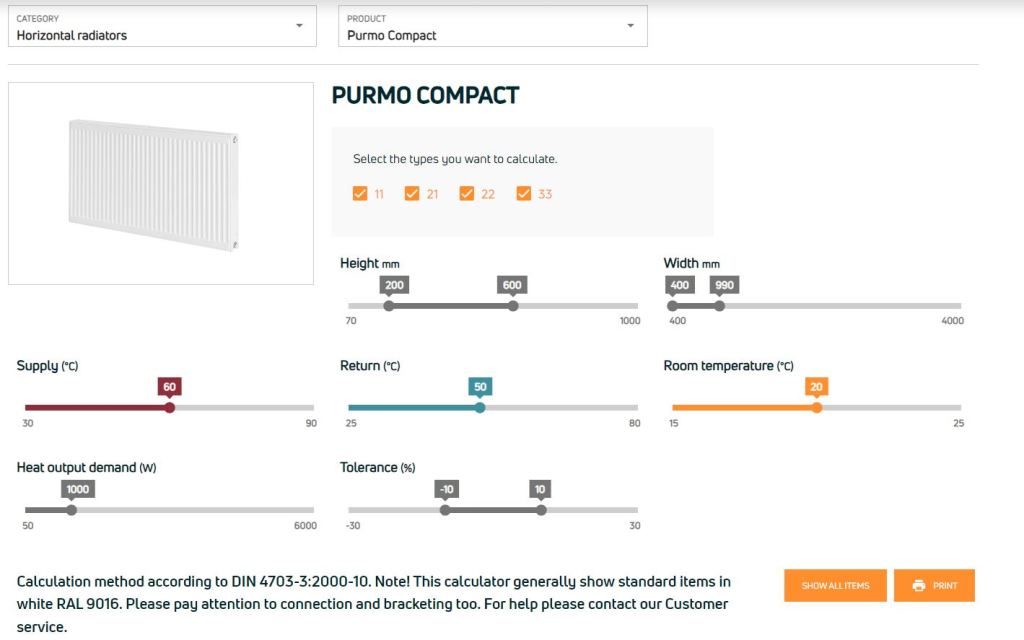
Underfloor heating is not advised due to the limited surface area available. Furthermore is that area even more limited and taken up by the various beds where the plants will be grown year round. We are not going to use air-heaters as air itself, as previously mentioned, is the WORST medium to transfer heat. To dimension the radiator, I based myself on a calculator from the company called PURMO . Settings and choice as detailed in images below.
Step 3: Making it renewable
Now that we know how much energy our Bitcoin miner consumes as well as how much heat it produces we can make the entire operation “green”.
That is to say, we are going to make sure that the entire setup makes use of renewable energy.
That way we are effectively mining Bitcoin entirely on renewable energy AND heating up our greenhouse with waste-energy to grow our vegetables (which can be consumed or sold..).
A variety of renewable technologies exist which allow households to produce their own electricity. There exists:
- Photovoltaic modules
- Micro wind turbines
- Microhydropower Systems
- Bioreactors with generators
- …
The most readily available and high electricity producing solution will be the Photovoltaic (solar) panels.
To dimension the solution is rather easy.
Just add enough until the demand is covered.
But in this case-study I will make use of a real-life situation AND want to ascertain that the miner keeps working 100% renewable (so even during the night).
We know that the miner itself uses 3.268kW of energy.
Taking into account the additional energy demand of the pump and regulation system of the “boiler”, we will need to cover AT LEAST 3.4kWh of energy during the day.
But we want to run our miner 24/7 which means that it needs to run on renewable energy during the night as well. To fix this will we need Home Energy Storage System (batteries/power-walls) and need to over-dimension them to cover the demand at night.
This is slightly different than with traditional systems as these are designed with low electric demand during the night (and not continuous demand as with Bitcoin mining and in this case study). Energy consumption throughout the day, which applies to most households in the Western world, looks like this (2):
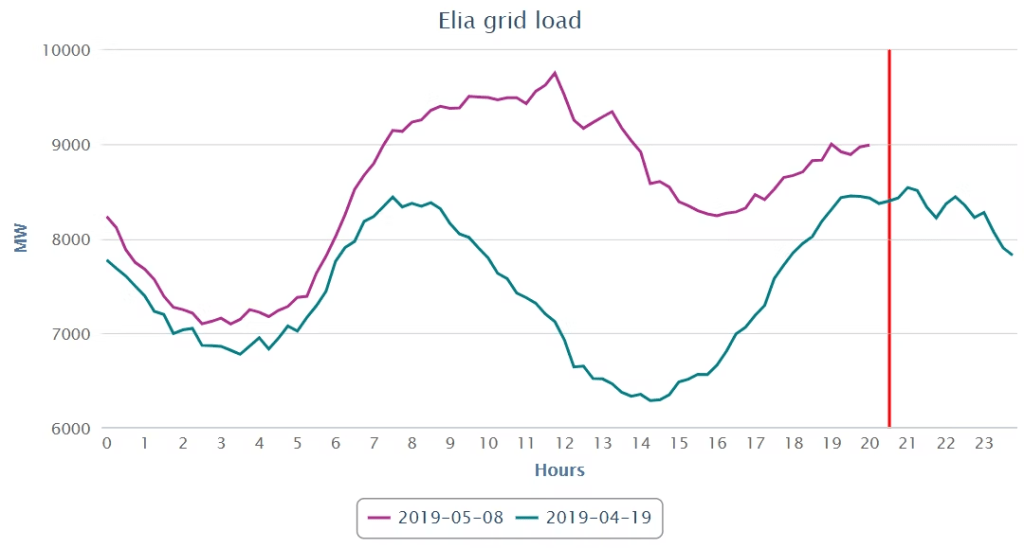
Source: EOS Wetenschap.
(2) The image shown shows the grid load in MW over the span of the day. The graph correlates with retail demand of energy during the day and night.
Let’s dimension our Photovoltaic modules. Throughout the day we want our solar panels to cover the entire 3.4kWh from the mining setup. Going by the technical details of a photovoltaic module by Viessmann (Vitovolt 300 M405WK) it has a rated output of 405W per panel.
Now, we need to be conscious here and point out that it is its MAXIMAL rate when placed under optimal conditions (no shade, perfect orientation). In reality will the output change due to orientation and inclination of the panels. At home I have an extension where the laundry-room and bathroom are situated. The roof here is at an inclination of about 15-20% and has an available surface area of 3m by 12m (36m2) orientated South-West. The inclination and orientation is important to determine the percentual decrease in energetic output of the photovoltaic modules. This can be determined with an “irradiation disc” (see below).
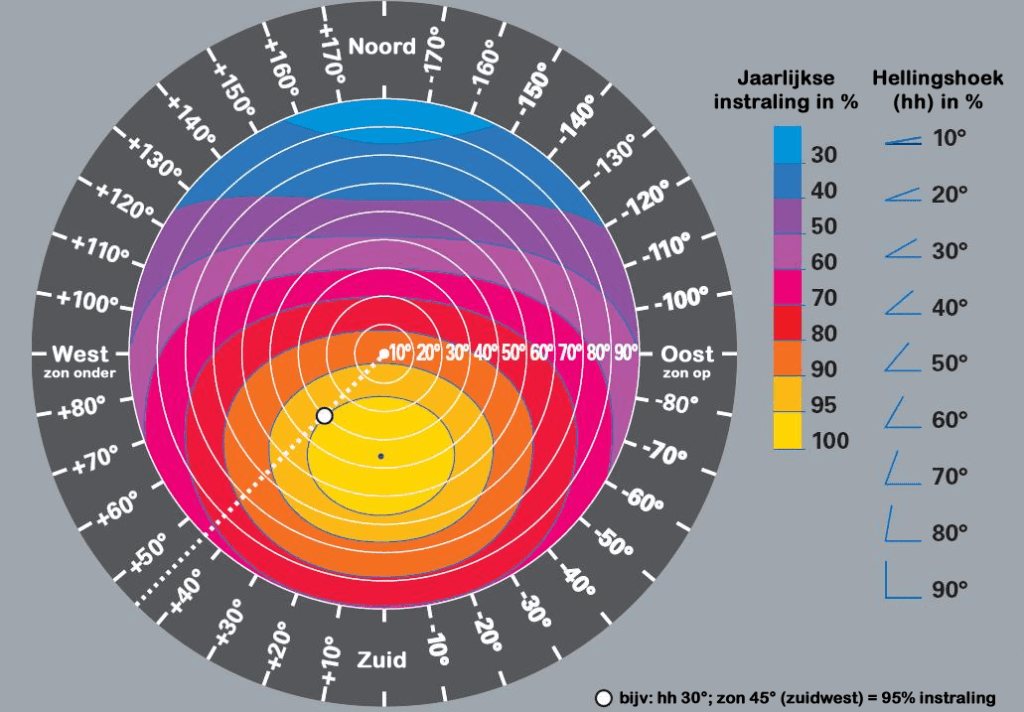
Based on the above chart and the given details ( The roof at an inclination of about 15-20% and orientated South-West.) indicates that the panels will give about 95% of the rated output.
Now we calculate. The panels have a rated output of 405W and due to placement will I only be able to use 95% of their rated output which means they’ll (at best) give me 384.5W per panel.
I need to cover 3.4kWh which means that I’ll need 9 modules (Vitovolt 300 M405WK) at least.
Now is it important to remember that I will be needing more energy in order to assure myself that the miner continues to operate even during the night. I will over-dimension the system in order to not only charge the Home Energy Storage System but have it cover some of my “normal” energy consumption as well. I do not do so by doubling but by adding 30% capacity (or 3 additional modules) to get a total output rate of 4.614kW in total.
Each module has a size of 1.14mx1.72m = 1.96m2.
As I need 12 modules (12 x 1.96m2) I will need a total of 23m2 to cover the electric demand.
As mentioned earlier in this step do I have 36m2 available which implies I have even some room to spare.
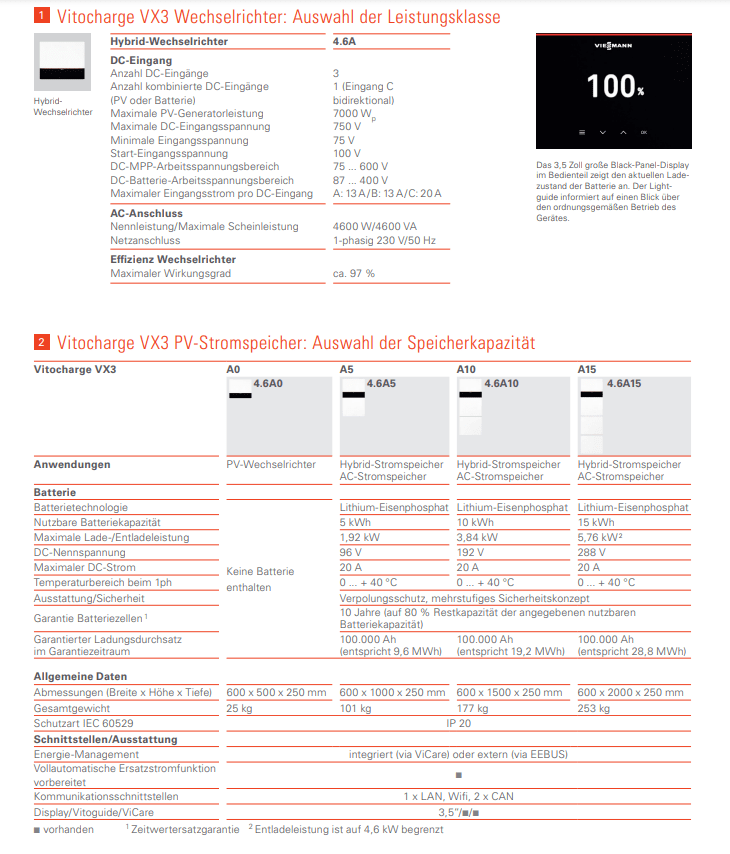
Now to dimension the Home Energy Storage System, this is rather easy and I need to base myself on the newly calculated output rate. I choose Vitocharge VX3 A15 as home storage system.
Based on the available technical details has this system the capability to store 5.76kW in electrical energy (see image below). This means it is capable to store a sufficient amount of energy to keep my Bitcoin miner running throughout the night AND cover the basic energy consumption during the night.
Step 4 conclusion:
A lot of work has gone into calculating the feasibility of:
- (The ROI of the miner)
- The heat load needed to warm the greenhouse
- The heat production of the miner
- Calculating Photovoltaic need, demand and production
- Dimensioning the Home Energy Storage System
By following all the aforementioned steps should it become much easier for fellow Crypthusiasts, and Bitcoin miners, to create a sustainable mining solution as well as a renewable year round greenhouse farming solution by making use of waste energy (heat) from a renewable Bitcoin mining rig.
Some ending notes:
– Naturally will the profitability calculation become slightly more complicated as, to be correct, the additional costs of the installation (solar panels and HESS) need to be accounted for.
– Few of the great objections against Bitcoin are disproved in this theoretical case study. Not only is the ENTIRE installation renewable and non-reliant on fossil fuel, mining is even being used to grow a variety of plants year round in a renewable way (which can be sold for profit or even privately used).
– The entirety of the study has been made with existing and proven technologies. In due time will some of the data I used here become outdated as technology advances and becomes more performing. Even now are there already more performing photovoltaic modules than the ones used in this case study (by the same producer). There are already more performing miners than the one mentioned.
– When calculating the heat needed for the greenhouse did I act as if it was a rectangular cuboid whereas in reality it has a double inclined roof. It means I actively over-dimensioned the heating need of the greenhouse. The reasons thereof are rather simple: it allows me to simplify the calculations, it allows for some reserve to be built-up and the miner dynamically steered, … and the main reason is that I had no information concerning the inclination and roof surface of the greenhouse.
I hope you enjoyed reading this case study and should there be any questions concerning this case study, feel free to contact me for clarifications.
You may find all my socials here: Linktree
 Bit-Block.org
Leave a reply to REVIEW: Antminer S9 Space Heater Edition – Gracious Interests Cancel reply