The node wars rages on. BIP 444 was renamed BIP 110 (but functionality remained) and it is slowly being pushed through in order to halt spam propagation on the network.
A new proposition (BIP) has been made by a person called “Claire Ostrom” which is called “The Cat – Non-monetary UTXO Cleanup on Bitcoin”.
While my goal is to focus on the content of this proposal, a few points (which will be addressed later) stand out to take a more balanced approach and not blindly accept the proposal “because it is anti-spam”. The idea in Bitcoin is to always “verify, do not trust”. “Improvement Proposals” always need some context and correct framing. Code can do a lot of things and each “improvement” can come with a hidden cost that makes it less of an improvement and more of a liability.
With that said:
The breakdown
What does this proposal do? — — — —
Taken directly from Github (screenshot 8/12/2025):
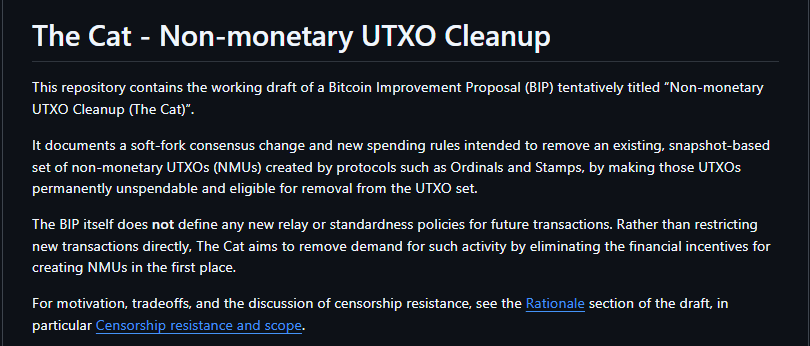
Basically, the proposal describes a method of removing non-monetary UTXO (Unspent Transaction Outputs). This means it describes a method to document transactions made solely for inscribing information (i.e. spam inscriptions) onto the Bitcoin ledger and the means to make them unspendeable in order to disincentivize spammers to abuse the Bitcoin ledger.
Disincentivation is achieved by making these NMU’s (Non-monetary UTXO’s) unspendeable and costly to move.
While the wording “eligible for removal” makes it seem that these inscriptions are to be “deleted”, reality is that these inscriptions will remain on the ledger in an archival state but can no longer be moved. They can be removed from the live UTXO set which frees up resources for noderunners.
In more plain English terms:
If you have an Ordinal/NFT in your wallet, you will no longer be able to transfer it to someone else. It will remain stuck forever inside that wallet.
Important to note on this proposal:
– It does not add new opcodes
– It does not expand Bitcoin’s scripting language or programmability.
What it does is add an additional consensus concept (NMU’s) to state, network wide, which UTXO’s can no longer be spent.
This means implementing a filter on EXISTING UTXO’s which are known to be used for non-monetary purposes (i.e. inscriptions/spam).
How does The Cat differentiate between NMU’s and MU’s (Monetary UTXO’s)?—
This is achieved by making use of known indexes as commonly used by Ordinals and Stamps.
The setup is rather simple:
When you go on a blockchain explorer for Bitcoin, all you can see is data. A first determination between “potential” spam and monetary use can be based on transaction size (i.e. how many bytes a transaction takes up). This approach is flawed and may lead classifying MU’s as NMU’s. What Ordinals and Stamps do is having special “glasses” which allows to make their inscriptions visible. The Cat takes these special “glasses” in order to see the inscriptions and uses it to tag the NMU’s with 100% certainty.
The Cat also makes use of a snapshot. This means at a specific date will a “snapshot” of the Bitcoin ledger be made and the proverbial glasses used to tag each and every inscription made in order to make the associated UTXO unspendeable.
It is an elegant solution which allows for repeated use in further timeframes should BIP 110 (formerly BIP 444) not come to fruitition to prevent more spam to be saved.
Difference between The Cat and BIP 110 (formerly BIP 444) —
As can be deduced from the previous title do The Cat and BIP 110 have different focus.
BIP 110 is all about preventing new spam making its way onto the Bitcoin blockchain.
The Cat is all about existing spam and making it unspendeable (i.e. prevent people from getting scammed).
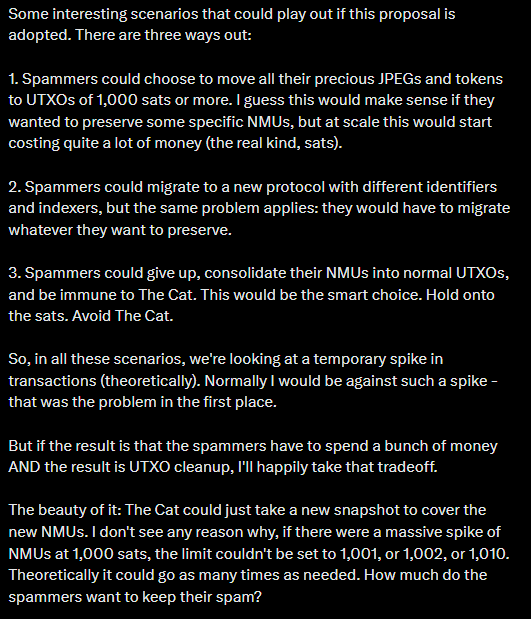
@Lukedewolf gave 3 possible scenarios for the spammers in an appraisal thread in regards to the topic at hand:
Discussion and controversies
As mentioned in the introduction is caution needed.
While a majority of Bitcoiners understand what spam is, how it affects the network and the need for halting it (Bitcoin as a currency, not data-storage) do we need caution still in regards to combating it.
While people may blindly acknowledge and agree with the premises The Cat offers, correct framing is still a must.
The rationale of the proposal itself hints at caution and determines the limits of its intended use. It also makes aware that similar approaches CAN be used to even invalidate monetary UTXO’s based on other premises. It opens the door to censorship on Bitcoin. A very contentious topic and something which is opposite to the ideals Bitcoin envelops! Do not trust, verify! More than ever.
Further of note is the current friction which exists in regards to Bitcoin Core vs the anti-spam movement.
The Cat itself is seeing censorship already in regards to entering Bitcoin development:
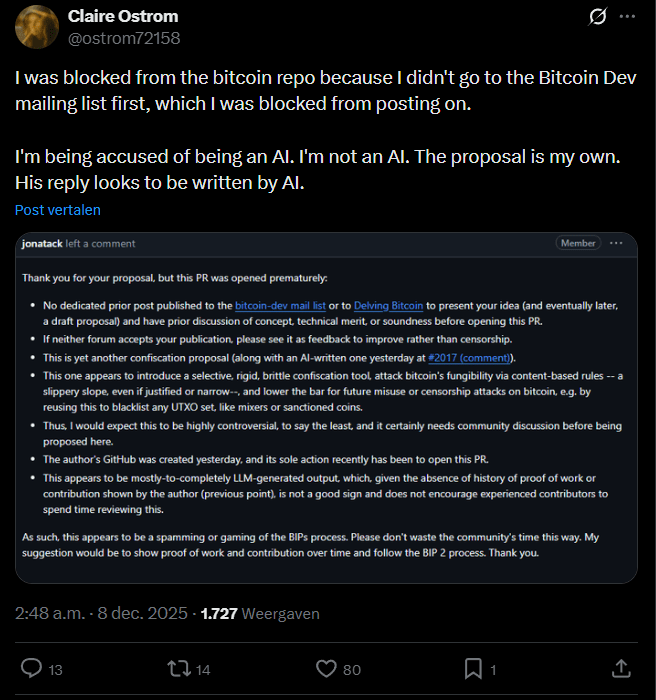
I leave it in the middle if the author is in the right or not, a few facts DO stand out:
- Author of the proposal literally came out of nowhere (unknown dev) both on social media as on dedicated platforms
- The proposal IS highly controversial due to its censorship implications
None the less should things be discussed based on their merit and content. The Cat has dedicated work and is obviously well-thought out as it highlights itself all the potential risks and does utmost effort to frame itself in the correct light.
I will leave judgement up to each and every individual user.

 Bit-Block.org
Leave a comment